
Artificial Intelligence didn’t suddenly appear with tools like ChatGPT or self-driving cars. Long before all of this, someone had to ask a simple but powerful question:
Can machines actually think?
That question led to an entire field. And if you trace it back far enough, one name keeps showing up – John McCarthy.
Who is the Father of Artificial Intelligence?
John McCarthy is known as the Father of Artificial Intelligence.
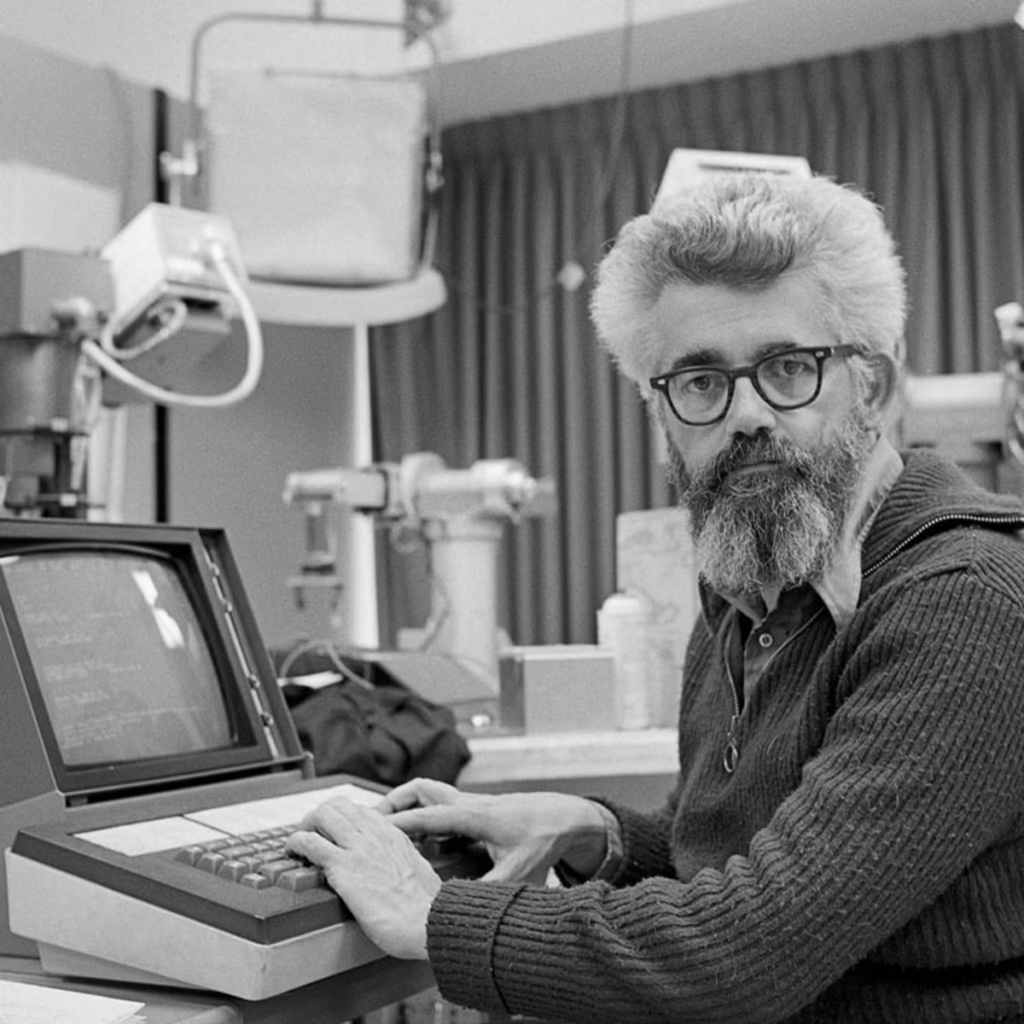
But that title isn’t just symbolic. He didn’t just contribute to AI, he gave it a name, direction, and a serious academic foundation.
The Moment That Started It All
Back in 1956, McCarthy organized something called the Dartmouth Conference.
At the time, computers were still primitive. The idea of machines “thinking” sounded more like science fiction than science. But McCarthy believed otherwise.
He introduced the term “Artificial Intelligence” for the first time and brought together a small group of researchers to explore it.
That event is now considered the starting point of AI as a real field of study.
What Made John McCarthy Different?
A lot of scientists were thinking about intelligent machines. But McCarthy stood out for a few reasons.
He didn’t just imagine AI, he defined it
Giving something a name might sound simple, but it matters. Once “Artificial Intelligence” became a defined concept, research around it became focused and structured.
He built tools for the future
McCarthy created LISP, one of the first programming languages designed specifically for AI.
For years, it was the go-to language for researchers working on machine intelligence. Even today, many AI concepts trace back to ideas explored through LISP.
He thought long-term
While others focused on short-term experiments, McCarthy was more interested in the bigger picture – machines that could reason, learn, and handle problems like humans.
That vision still drives AI development today.
Was He the Only One Behind AI?
Not really. Calling McCarthy the “father” of AI doesn’t mean he worked alone.
There were other important figures, each contributing a piece of the puzzle.
Alan Turing
Often seen as the one who asked the original question: Can machines think?

His idea of the Turing Test is still discussed today.
Geoffrey Hinton
Played a huge role in bringing neural networks back into the spotlight.

A big reason why modern AI (like what we use today) actually works.
Yoshua Bengio and Yann LeCun

Key figures behind deep learning – the technology powering most modern AI systems.
So while McCarthy laid the foundation, others helped build the structure on top of it.
Why This Still Matters
It’s easy to think of AI as something modern. But understanding where it started actually helps you make sense of where it’s going.
The tools we use today – chatbots, recommendation systems, image generators, all trace back to early ideas about machine intelligence.
And those ideas didn’t come from nowhere.
Final Thought
What’s interesting about McCarthy isn’t just what he built, it’s what he believed.
At a time when computers could barely perform basic tasks, he was already thinking about machines that could reason and learn.
That kind of thinking is what pushed AI forward.
And in many ways, we’re still catching up to that vision.
Read Next: 5 Common VPN Myths You Should Never Fall For



Leave a Reply