
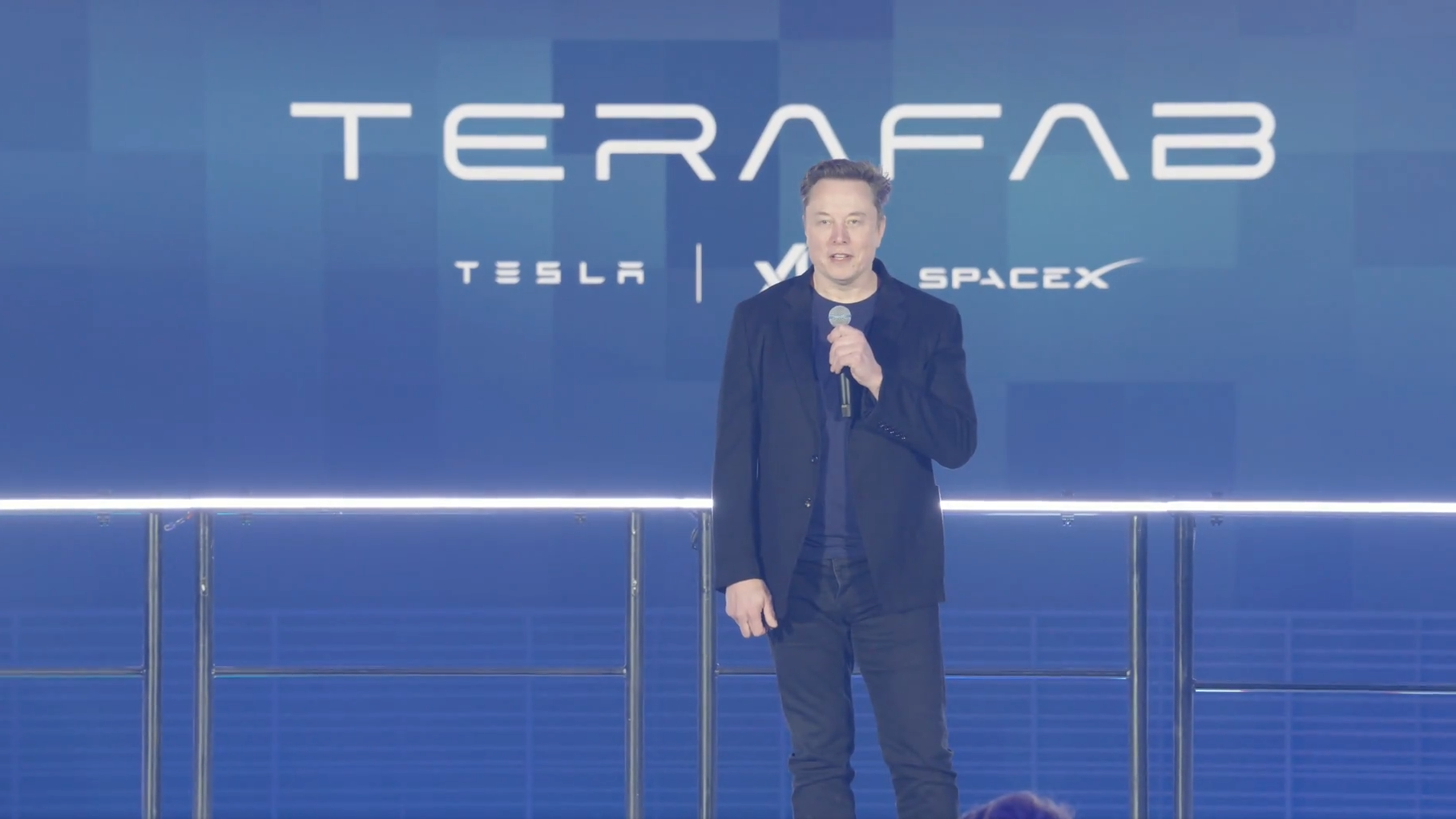
Elon Musk has unveiled one of the most ambitious industrial projects of the decade — a $25 billion semiconductor manufacturing initiative dubbed “Terafab”, aimed at reshaping the global supply of artificial intelligence chips and accelerating his broader vision for robotics and space-based computing.

Announced during a high-profile event in Austin, Texas, the project is a joint venture between Tesla, SpaceX, and xAI, consolidating chip design, manufacturing, and packaging into a single vertically integrated ecosystem.
A Bet on Controlling the Future of AI Hardware
Terafab is designed to produce more than one terawatt of AI compute annually, a scale that far exceeds current global semiconductor output for advanced AI workloads.

Musk’s motivation is clear: existing chip suppliers cannot keep pace with the explosive demand from his companies’ AI ambitions — from autonomous vehicles to humanoid robots and orbital data centers.
At the launch, Musk framed the project as a necessity rather than a choice, emphasizing that without direct control over chip production, future innovation would be bottlenecked by supply constraints.
Inside “Terafab”: A Fully Integrated Chip Ecosystem
Unlike traditional semiconductor fabs, Terafab aims to bring every stage of chip production under one roof, including:
- Chip design and architecture
- Lithography and fabrication
- Memory production
- Advanced packaging and testing
This level of integration is intended to dramatically reduce iteration time, allowing engineers to design, test, and refine chips faster than ever before.
The initial facility will be built near Tesla’s existing Gigafactory in Austin, with plans to expand into a much larger, multi-site operation in the future.
Two Chips, Two Worlds: Earth and Space
Terafab will focus on producing two distinct categories of chips:
- AI chips for Earth-based systems
- Powering Tesla’s Full Self-Driving platform
- Supporting humanoid robots like Optimus
- Enabling next-generation AI data centers
- Radiation-hardened chips for space
- Designed for satellites and orbital computing
- Built to withstand extreme temperatures and cosmic radiation
Notably, Musk has indicated that up to 80% of Terafab’s output could be allocated to space-based applications, underscoring his long-term ambition to move AI infrastructure beyond Earth.
The Bigger Vision: Orbital AI Data Centers
Terafab is not just about chips — it is a foundational piece of Musk’s broader plan to build AI data centers in orbit.
Space-based infrastructure, Musk argues, offers key advantages:
- Nearly unlimited solar energy
- Reduced cooling constraints
- Lower long-term operational costs
SpaceX has already explored launching large-scale satellite networks capable of hosting AI workloads, potentially transforming how and where computing happens in the future.
Timeline and Challenges Ahead
While the announcement has generated significant excitement, key details remain uncertain:
- Production timeline: Early chip output could begin by 2027, with full-scale operations later.
- Capital requirements: The $25 billion estimate may rise significantly as the project scales.
- Technical hurdles: Semiconductor manufacturing remains one of the most complex industries in the world.
Analysts remain divided, with some calling the project visionary and others warning it may require partnerships with established chipmakers to succeed.
Industry Impact: A New Era of Vertical Integration?
If successful, Terafab could fundamentally alter the semiconductor landscape by:
- Reducing reliance on companies like TSMC and Samsung
- Creating a closed-loop AI ecosystem controlled by Musk’s companies
- Accelerating the development of autonomous systems and robotics
It could also trigger a new wave of investment in semiconductor infrastructure, as rivals attempt to keep pace.
The bottom line
Terafab represents a high-stakes attempt to secure control over one of the most critical components of modern technology. It is both an industrial project and a strategic move aimed at reducing reliance on external suppliers.
Whether it succeeds will depend on execution, timing and the ability to navigate one of the most demanding sectors in global manufacturing. For now, it signals that the competition to build the backbone of the AI era is only intensifying.
Read Next: How Websites Track You in 2026 (Cookies, Fingerprinting and More) and How to Stop It


Leave a Reply